
30$ - Open the File Now
- Dedicated
- Several payment options supported
- Free samples once needed
- All chapters are included
- Digital File Downloadsupport / instant chat – contact us Form
Category : Higher Education
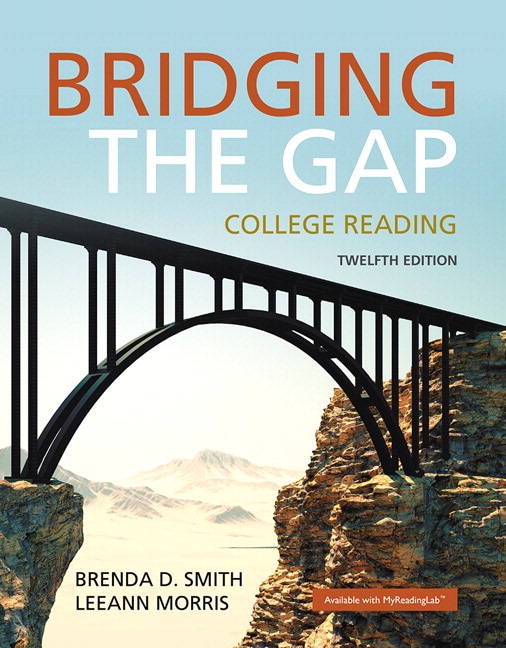
INSTANT DOWNLOAD of Bridging the Gap: College Reading, 12th Edition by Brenda D. Smith, San Jacinto College LeeAnn Morris, San Jacinto College
Get Bridging the Gap: College Reading, 12th Edition Solution manual for 30$
Table of Contents
What Can We Learn From Cognitive Psychology and Neuroscience?BRAIN BOOSTERBRAIN BOOSTER: Are You Paying Attention?Help Your Brain Absorb New Information
External DistractionsInternal DistractionsBRAIN BOOSTER: Are You Curious?READER’S TIP: Improving ConcentrationREADER’S TIP: Managing Electronic Communication
Varying Rate and Technique to Fit PurposeRate Variations and Prior KnowledgeREADER’S TIP: Efficient Reading: Adjusting Rate and Technique to Material and PurposeWhat Is Your Baseline Reading Rate?BRAIN BOOSTER: Music to Our Ears and to Our BrainsHabits for Faster Reading
Plan for SuccessBefore Taking a TestBRAIN BOOSTER: Balance Memorization and Application in Test PreparationDuring the TestAfter the TestBRAIN BOOSTER: Turn Mistakes Into SuccessesRecognize the Major Types of Comprehension QuestionsREADER’S TIP: Key Words in Essay Questions
SUMMARY POINTSSELECTION 1 PSYCHOLOGY“Are you Stalling? Win the Battle Against Procrastination!” from Samuel E. Wood, Ellen Green Wood, and Denise G. BoydCONCEPT PREP FOR PSYCHOLOGYSELECTION 2 HISTORY“Home Front Workers, Rosie the Riveter, and Victory Girls” from Jacqueline Jones, et al.CONCEPT PREP FOR HISTORYSELECTION 3 SCIENCE“Is there Enough Earth for Everyone?” from Teresa Audesirk, Gerald Audesirk, and Bruce E. ByersVOCABULARY BOOSTER: OVER, UNDER, AROUND, AND THROUGH
Four Types of ReadersThe Stages of Reading
Signposts for PreviewingREADER’S TIP: Ask Questions While PreviewingPreview to Activate SchemataBRAIN BOOSTER: Schemata and Your Brain
Integrating Ideas: How Do Good Readers Think?MetacognitionREADER’S TIP: Using Thinking Strategies While ReadingREADER’S TIP: Developing Metacognition for Reading
Recalling Through WritingThe Three Steps of RecallingREADER’S TIP: Thinking After ReadingBRAIN BOOSTER: Use It to Remember It!SUMMARY POINTSSELECTION 1 HISTORY“Madam C. J. Walker: Business Savvy to Generous Philanthropy” from America.gov ArchiveSELECTION 2 HEALTH“High-Risk Drinking and College Students” from Rebecca J. Donatelle and Patricia KetchumSELECTION 3 BUSINESS“Toms Shoes: ‘Be the Change You Want to See in the World’” from Gary Armstrong and Philip KotlerCONCEPT PREP FOR BUSINESSVOCABULARY BOOSTER: THE GOOD, THE BAD, AND THE UGLY
Building Knowledge NetworksThe Study ProcessOrganizing Textbook InformationBRAIN BOOSTER: Exercise to Boost Brain Power
Why Annotate?READER’S TIP: How to AnnotateWhen to Annotate
When and How to Take NotesThe Cornell MethodREADER’S TIP: How to Take Notes: The Cornell MethodOutliningREADER’S TIP: Guidelines for Successful OutliningBRAIN BOOSTER: Sleep and Problem SolvingMappingREADER’S TIP: How to MapSUMMARY POINTSSELECTION 1 BUSINESS COMMUNICATIONS“Watch Your Language!” from Gary Armstrong and Philip KotlerCONCEPT PREP FOR COMMUNICATIONS AND LANGUAGESELECTION 2 HEALTH“Managing Stress in College” from Rebecca J. DonatelleCONCEPT PREP FOR HEALTHSELECTION 3 CRIMINAL JUSTICE“Police DNA Collection Sparks Questions” from the Associated PressVOCABULARY BOOSTER: WHO’S WHO IN MEDICINE?
Remembering New Words and Unlocking MeaningAssociate Words in PhrasesAssociate Words with Rhymes or SoundsBRAIN BOOSTER: Use Your Senses to Make More Sense!Associate Words With ImagesSeek ReinforcementCreate Concept CardsUse Strategies to Unlock Meaning While Reading
Definition or SynonymElaborating DetailsExamplesComparisonContrastAntonymsLimitations of Context CluesMultiple Meanings of a Word
Using a DictionaryUsing a GlossaryUsing a ThesaurusBRAIN BOOSTER: Meaning Matters!
Exploring Word OriginsSolving AnalogiesREADER’S TIP: Categories of Analogy RelationshipsStudying Easily Confused WordsSUMMARY POINTSSELECTION 1 HEALTH“Technology and Health” from Rebecca J. DonatelleVOCABULARY BOOSTER: WHAT’S IN, WHAT’S OUT?WHAT’S HOT, WHAT’S NOT?
What Is a Topic?What Is a Main Idea?What Are Supporting Details?Distinguishing Topics, Main Ideas, and Details: A Closer Look
Prior Knowledge and Constructing the Main IdeaIdentifying Main Ideas Among SentencesREADER’S TIP: Using Three Questions to Find the Main IdeaQuestioning for the Main Idea
The Topic SentenceHow Common Are Stated Main Ideas?Where Are Stated Main Ideas Located?
READER’S TIP: Signals for Significance
Unstated Main Ideas in SentencesUnstated Main Ideas in Paragraphs
READER’S TIP: Getting the Main Idea of Longer SelectionsBRAIN BOOSTER: Brains Need the Right Amount of Sleep
Why Summarize?READER’S TIP: How to SummarizeBRAIN BOOSTER: Chronic Stress and the BrainSUMMARY POINTSSELECTION 1 PSYCHOLOGY“The Obedience Study” from Carole Wade, Carol Tavris, and Maryanne GarryCONCEPT PREP FOR PSYCHOLOGYSELECTION 2 SHORT STORY“On the Sidewalk, Bleeding” from Evan HunterCONCEPT PREP FOR LITERATURESELECTION 3 CRIMINAL JUSTICE“Fighting Violent Gang Crime with Math” from Stuart WolpertVOCABULARY BOOSTER: THE SUN, THE MOON, AND THE STARS
Words That Signal Addition
Words That Signal Examples or Illustrations
Words That Signal Time or Sequence
Words That Signal Comparison
Words That Signal ContrastREADER’S TIP: Transitions and Their FunctionsWords That Signal Cause and Effect
BRAIN BOOSTER: Brains Like Patterns
Simple ListingDefinitionDescriptionTime Order, Sequence, or NarrationComparisonContrastComparison and ContrastCause and EffectClassificationSummaryLocation or Spatial OrderGeneralization and ExampleREADER’S TIP: Patterns of Organization and Signal Words
BRAIN BOOSTER: Watering the Brain
SUMMARY POINTSSELECTION 1 COMMUNICATIONS“Managing Conflict” from Joseph A. DeVitoSELECTION 2 HISTORY“Barbara Johns Leads a Student Strike” from Clayborne Carson, et al.CONCEPT PREP FOR ART HISTORYSELECTION 3 BUSINESS“Why is Papa John’s Rolling in the Dough?” from Courtland L. Bovée, John V. Thrill, and Barbara E. SchatzmanVOCABULARY BOOSTER: CAN I GET THAT IN WRITING?
Implied Meaning in HumorBRAIN BOOSTER: The Brain’s Pleasure Center and Learning
IdiomsSimilesMetaphorsHyperbolePersonificationVerbal IronyFigurative Language in Poetry
Inferences Based on FactsInferences Based on the Voice of a Speaker or NarratorInferences Based on Action and DescriptionInferences Based on Prior KnowledgeBRAIN BOOSTER: Boost Brain Power ThroughCollaborationExpanding Prior KnowledgeREADER’S TIP: Making Inferences
SUMMARY POINTSSELECTION 1 SHORT STORY“A Dip in the Poole” from Bill PronziniCONCEPT PREP FOR PHILOSOPHY AND LITERATURESELECTION 2 PHILOSOPHY“Coyote” from Robert S. EllwoodSELECTION 3 PERSONAL NARRATIVE“Fear the College Years” from John CorcoranCONCEPT PREP FOR POLITICAL SCIENCEVOCABULARY BOOSTER: SAY, WHAT?
Textbooks and the Author’s Point of ViewWhat Is Bias?READER’S TIP: Questions to Uncover BiasThe Importance of the Reader’s Point of ViewBRAIN BOOSTER: Male and Female Brains and Their Points of View
Using Tone and Other Clues to Determine the Point of View in Editorial CartoonsREADER’S TIP: Recognizing an Author’s ToneSUMMARY POINTSSELECTION 1 PHILOSOPHY“Decision” from Gary R. Kirby and Jeffery R. GoodpasterSELECTION 2 SCIENCE“Earth’s Changing Climate” from Teresa Audesirk, Gerald Audesirk, and Bruce E. ByersSELECTION 3 PSYCHOLOGY“Mental Disorder and Personal Responsibility” from Carole Wade, Carol Tavris, and Maryanne GarryVOCABULARY BOOSTER: LIGHTS, CAMERA, ACTION!
READER’S TIP: How to Read Graphic Illustrations
DiagramsTablesMapsPie GraphsBar GraphsCumulative Bar GraphsLine GraphsFlowcharts
SUMMARY POINTSSELECTION 1 PERSONAL NARRATIVE“Little Income, Big Debt: Managing Money in College” from Trent HammSELECTION 2 SCIENCE“The Risks and Benefits of Weight Loss Plans” from Jane B. Reece et al.SELECTION 3 SOCIOLOGY“People, Technology, and the Environment” from John J. MacionisVOCABULARY BOOSTER: PLAY IT AGAIN, SAM
What Is Analytical Thinking?What Is Critical Thinking?Critical Thinking Skills and College GoalsREADER’S TIP: Four Habits of Effective Critical ThinkersBarriers to Critical Thinking
Step 1: Identify the Position on the IssueStep 2: Identify the Support in the ArgumentREADER’S TIP: Types of Support for ArgumentsStep 3: Evaluate the SupportStep 4: Evaluate the Argument
Explanation of the Four Steps
BRAIN BOOSTER: The Creative BrainSUMMARY POINTS
SELECTION 1 CRIMINAL JUSTICE“High Technology and Criminal Opportunity” from Frank J. SchmallegerSELECTION 2 CRIMINAL JUSTICE“Fighting Crime with Technology” from Frank J. SchmallegerSELECTION 3 ESSAY“The Writer and the Troll” from Lindy WestVOCABULARY BOOSTER: FOREIGN TERMS
DIGITAL AND ELECTRONIC FILES DOWNLOAD
we provides electronic and soft downloadable products for the selected Textbooks and not the actual hard copy Materials. There is no need to provide us with your own physical shipping address, instead, we will need only your own email address in which we are going to attach the files for you. We sell potential questions and answers that instructors and teachers based on when making exams and tests.
ANONYMOUS ORDERS
All orders are kept anonymous and safe. We do not record nor share client details for any reason.You get what you paid for securely and anonymously..
EASY READ AND DOWNLOADABLE PRODUCTS
Clients will get 100% clean and complete Digital study guides which you can download to your own device directly and available in the most contemporary readable format.
INSTANT PAYMENT – INSTANT DOWNLOAD
We implement instant payment and instant files delivery method. Clients are able to pay for their materials directly from the online store using either the credit cards or PayPal and then download the purchased file by login into their accounts or get an email attachment.
MAJOR PAYMENT GATEWAYS
We accept several payment options and that includes Credit /Debit Cards, Paypal and Bitcoin.Clients who use PayPal are going to receive a payment invoice into their email which they sign up with. In case the email you sign up with is different than your own PayPal one, you can simply let us know by using the contact us form. Always check both your spam and Junk mail if you did not see incoming emails in your inbox.
FREE SAMPLES
For customer’s satisfaction, we provide free samples for any required Textbook solution or test bank to check and evaluate before making the final purchase..
NEED MORE DETAILS
We are always available to answer any further questions or queries you may have by using the contact us form, or send us message directly at newtourism@gmail.com


0 comments:
Post a Comment