
30$ - Open the File Now
- Dedicated
- Several payment options supported
- Free samples once needed
- All chapters are included
- Digital File Downloadsupport / instant chat – contact us Form
Category : Higher Education
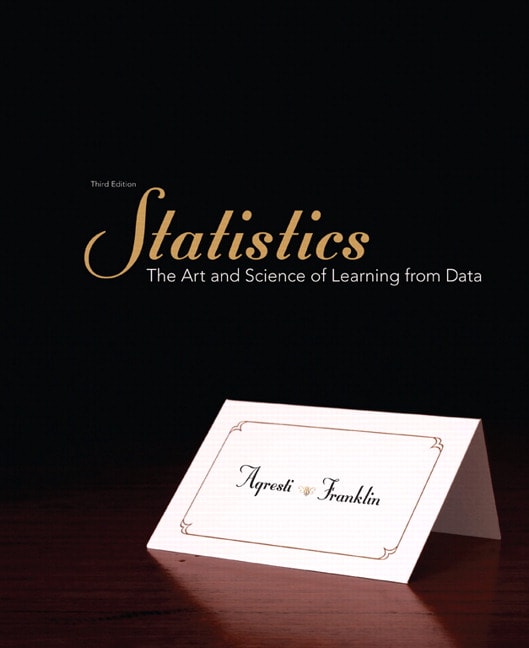
INSTANT DOWNLOAD of Statistics: The Art and Science of Learning from Data (Subscription), 3rd Edition by Alan Agresti, University of Florida Christine A. Franklin, University of Georgia
Get Statistics: The Art and Science of Learning from Data (Subscription), 3rd Edition Solution manual for 30$
Table of Contents
Part 1: Gathering and Exploring Data
1. Statistics: The Art and Science of Learning from Data
1.1 Using Data to Answer Statistical Questions
1.2 Sample Versus Population
1.3 Using Calculators and Computers
Chapter Summary
Chapter Problems
2. Exploring Data with Graphs and Numerical Summaries
2.1 Different Types of Data
2.2 Graphical Summaries of Data
2.3 Measuring the Center of Quantitative Data
2.4 Measuring the Variability of Quantitative Data
2.5 Using Measures of Position to Describe Variability
2.6 Recognizing and Avoiding Misuses of Graphical Summaries
Chapter Summary
Chapter Problems
3. Association: Contingency, Correlation, and Regression
3.1 The Association Between Two Categorical Variables
3.2 The Association Between Two Quantitative Variables
3.3 Predicting the Outcome of a Variable
3.4 Cautions in Analyzing Associations
Chapter Summary
Chapter Problems
4. Gathering Data
4.1 Experimental and Observational Studies
4.2 Good and Poor Ways to Sample
4.3 Good and Poor Ways to Experiment
4.4 Other Ways to Conduct Experimental and Nonexperimental Studies
Chapter Summary
Chapter Problems
Part 1 Review
Part 1 Questions
Part 1 Exercises
Part 2: Probability, Probability Distributions, and Sampling Distributions
5. Probability in Our Daily Lives
5.1 How Probability Quantifies Randomness
5.2 Finding Probabilities
5.3 Conditional Probability: The Probability of A Given B
5.4 Applying the Probability Rules
Chapter Summary
Chapter Problems
6. Probability Distributions
6.1 Summarizing Possible Outcomes and Their Probabilities
6.2 Probabilities for Bell-Shaped Distributions
6.3 Probabilities When Each Observation Has Two Possible Outcomes
Chapter Summary
Chapter Problems
7. Sampling Distributions
7.1 How Sample Proportions Vary Around the Population Proportion
7.2 How Sample Means Vary Around the Population Mean
7.3 The Binomial Distribution Is a Sampling Distribution (Optional)
Chapter Summary
Chapter Problems
Part 2 Review
Part 2 Questions
Part 2 Exercises
Part 3: Inferential Statistics
8. Statistical Inference: Confidence Intervals
8.1 Point and Interval Estimates of Population Parameters
8.2 Constructing a Confidence Interval to Estimate a Population Proportion
8.3 Constructing a Confidence Interval to Estimate a Population Mean
8.4 Choosing the Sample Size for a Study
8.5 Using Computers to Make New Estimation Methods Possible
Chapter Summary
Chapter Problems
9. Statistical Inference: Significance Tests about Hypotheses
9.1 Steps for Performing a Significance Test
9.2 Significance Tests about Proportions
9.3 Significance Tests about Means
9.4 Decisions and Types of Errors in Significance Tests
9.5 Limitations of Significance Tests
9.6 The Likelihood of a Type II Error (Not Rejecting H0, Even Though It’s False)
Chapter Summary
Chapter Problems
10. Comparing Two Groups
10.1 Categorical Response: Comparing Two Proportions
10.2 Quantitative Response: Comparing Two Means
10.3 Other Ways of Comparing Means and Comparing Proportions
10.4 Analyzing Dependent Samples
10.5 Adjusting for the Effects of Other Variables
Chapter Summary
Chapter Problems
Part 3 Review
Part 3 Questions
Part 3 Exercises
Part 4: Analyzing Association and Extended Statistical Methods
11. Analyzing the Association Between Categorical Variables
11.1 Independence and Association
11.2 Testing Categorical Variables for Independence
11.3 Determining the Strength of the Association
11.4 Using Residuals to Reveal the Pattern of Association
11.5 Small Sample Sizes: Fisher’s Exact Test
Chapter Summary
Chapter Problems
12. Analyzing the Association Between Quantitative Variables: Regression Analysis
12.1 Model How Two Variables Are Related
12.2 Describe Strength of Association
12.3 Make Inference About the Association
12.4How the Data Vary Around the Regression Line
12.5 Exponential Regression: A Model for Nonlinearity
Chapter Summary
Chapter Problems
13. Multiple Regression
13.1 Using Several Variables to Predict a Response
13.2 Extending the Correlation and R-squared for Multiple Regression
13.3 Using Multiple Regression to Make Inferences
13.4 Checking a Regression Model Using Residual Plots
13.5 Regression and Categorical Predictors
13.6 Modeling a Categorical Response
Chapter Summary
Chapter Problems
14. Comparing Groups: Analysis of Variance Methods
14.1 One-Way ANOVA: Comparing Several Means
14.2 Estimating Differences in Groups for a Single Factor
14.3 Two-Way ANOVA
Chapter Summary
Chapter Problems
15. Nonparametric Statistics
15.1 Compare Two Groups by Ranking
15.2 Nonparametric Methods For Several Groups and for Matched Pairs
Chapter Summary
Chapter Problems
PART 4 Review
Part 4 Questions
Part 4 Exercises
Tables
Answers
Index
Index of Applications
Photo Credits
DIGITAL AND ELECTRONIC FILES DOWNLOAD
we provides electronic and soft downloadable products for the selected Textbooks and not the actual hard copy Materials. There is no need to provide us with your own physical shipping address, instead, we will need only your own email address in which we are going to attach the files for you. We sell potential questions and answers that instructors and teachers based on when making exams and tests.
ANONYMOUS ORDERS
All orders are kept anonymous and safe. We do not record nor share client details for any reason.You get what you paid for securely and anonymously..
EASY READ AND DOWNLOADABLE PRODUCTS
Clients will get 100% clean and complete Digital study guides which you can download to your own device directly and available in the most contemporary readable format.
INSTANT PAYMENT – INSTANT DOWNLOAD
We implement instant payment and instant files delivery method. Clients are able to pay for their materials directly from the online store using either the credit cards or PayPal and then download the purchased file by login into their accounts or get an email attachment.
MAJOR PAYMENT GATEWAYS
We accept several payment options and that includes Credit /Debit Cards, Paypal and Bitcoin.Clients who use PayPal are going to receive a payment invoice into their email which they sign up with. In case the email you sign up with is different than your own PayPal one, you can simply let us know by using the contact us form. Always check both your spam and Junk mail if you did not see incoming emails in your inbox.
FREE SAMPLES
For customer’s satisfaction, we provide free samples for any required Textbook solution or test bank to check and evaluate before making the final purchase..
NEED MORE DETAILS
We are always available to answer any further questions or queries you may have by using the contact us form, or send us message directly at newtourism@gmail.com


0 comments:
Post a Comment